
Mark Twain didn’t exactly hide his preference for cats over humans. In fact, he seemed to take a kind of mischievous pride in it. Throughout his writings and personal letters, cats are treated not just as pets, but as companions worthy of admiration, respect, and often, better manners than people.
His famous quote about improving man by crossing him with a cat wasn’t just a joke. it reflected a genuine belief that cats possessed a kind of independence and dignity that humans often lacked.
Visitors to Twain’s home frequently noted how comfortable the cats were, and how clearly they ruled the place. Twain encouraged it. He owned as many as 19 cats at one time, allowed them on furniture, doted on them openly, and gave them fantastical and Biblical names. For Twain, cats weren’t beneath people, they were, in many ways superior.
Mark Twain’s cat names | quotes | rentals | Bambino
Mark Twain’s Best Cat Names
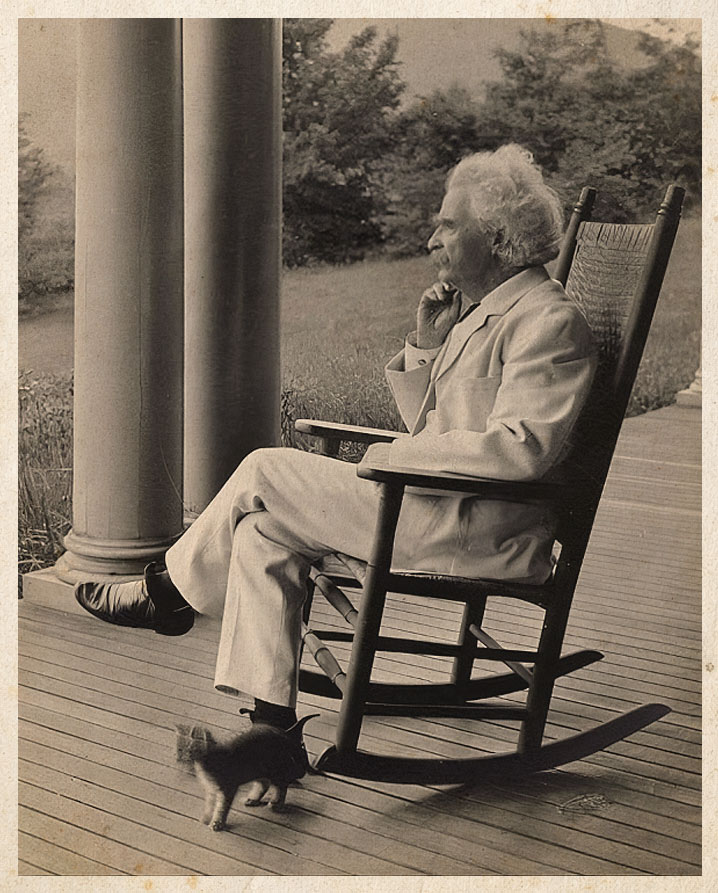
Mark Twain was a life-long cat-lover and owned many throughout his life. He often gave them fantastical, Biblical, and even diabolical names that reflected his sharp sense of humor and reverent worship for his cats. (source)
Here are Mark Twain’s best cat names:
- Apollinaris: A brand of mineral water that Twain liked
- Bambino: Italian word for “baby,” Twain inherited Bambino from his ill daughter
- Beelzebub: The Biblical “prince of demons,” also translated as, “lord of the house”
- Blatherskite: Someone who talks a lot of nonsense
- Buffalo Bill: Reflecting Twain’s fascination with American frontier culture
- Pestilence: A deadly disaster or disease
- Satan: The devil himself
- Sackcloth and Ashes were a Biblical reference to mourning and deep sorrow
- Sin: Willful violation of a religious principle
- Sour Mash: A whiskey-making technique
- Soapy Sal: Hmmm… sounds like one of Twain’s character names
- Tammany: (Tammany Hall) A powerful and corrupt political machine led by the nefarious Boss Tweed in the 1860s and 1870s
- Zoroaster: The ancient Persian prophet who preached of heaven and hell
Mark Twain was also known for his many cat quotes in his writing and books.
Mark Twain’s 10 Best Cat Quotes:
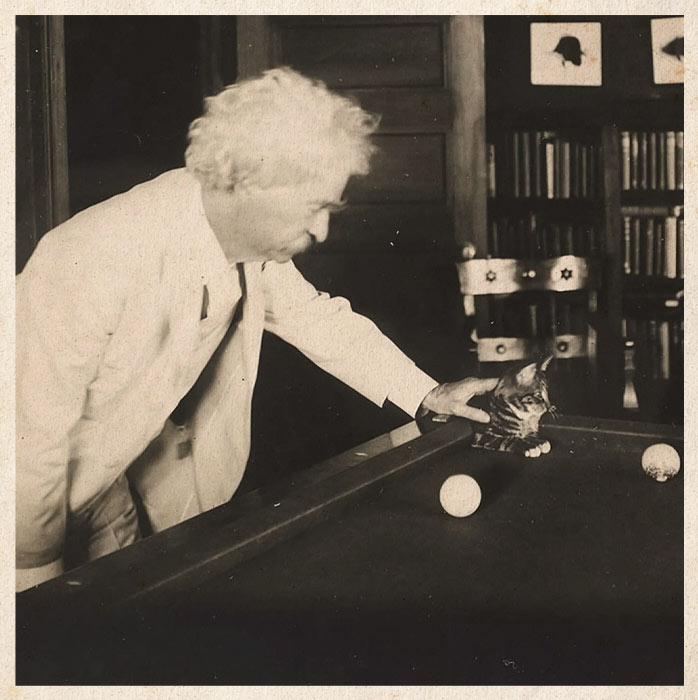
Not only did Mark Twain own a plethora of felines, but he also mused about them frequently in his writing, including his notebooks, letters, and in satirical books like Pudd’nhead Wilson. Here are Twain’s most famous quotes about cats:
- “Of all God’s creatures, there is only one that cannot be made the slave of the lash. That one is the cat.” notebook entry (1894)
- “If man could be crossed with the cat, it would improve man, but it would deteriorate the cat.” notebook entry (1894)
- “A man who carries a cat by the tail learns something he can learn in no other way.” Tom Sawyer Abroad – In other words, experience is the best teacher, especially for poor decisions
- “When a man loves cats, I am his friend and comrade, without further introduction.” Essay from “Who is Mark Twain?”
- “A cat is more intelligent than people believe, and can be taught any crime.” Notebook entry (1895)
- “One of the most striking differences between a cat and a lie is that a cat has only nine lives.” Pudd’nhead Wilson
- “A home without a cat… may be a perfect home, perhaps, but how can it prove title?” Twain adds that the sight of a cat makes the house’s “contentment and peace manifest to the world.” – Pudd’nhead Wilson
- “Perfect independence of character is found in the cat.” Pudd’nhead Wilson
- “I simply can’t resist a cat, particularly a purring one.” – Abroad with Mark Twain & Eugene Field (1922)
- “You may say a cat uses good grammar… it’s the sickening grammar they use.” Meaning that cats change from polite to vulgar and chaotic the moment they lose their composure or fight each other
Twain’s reverence for cats extended beyond his writing. In fact, he was once seen bowing low to two kittens at a screen door, stepping back to let them pass while saying, “Walk in, gentlemen. I always give precedence to royalty”.
While Mark Twain used cat quotes to provide social commentary in books like Puddn’head Wilson, he also wrote in several as actual characters.
Cats in Mark Twain’s Books
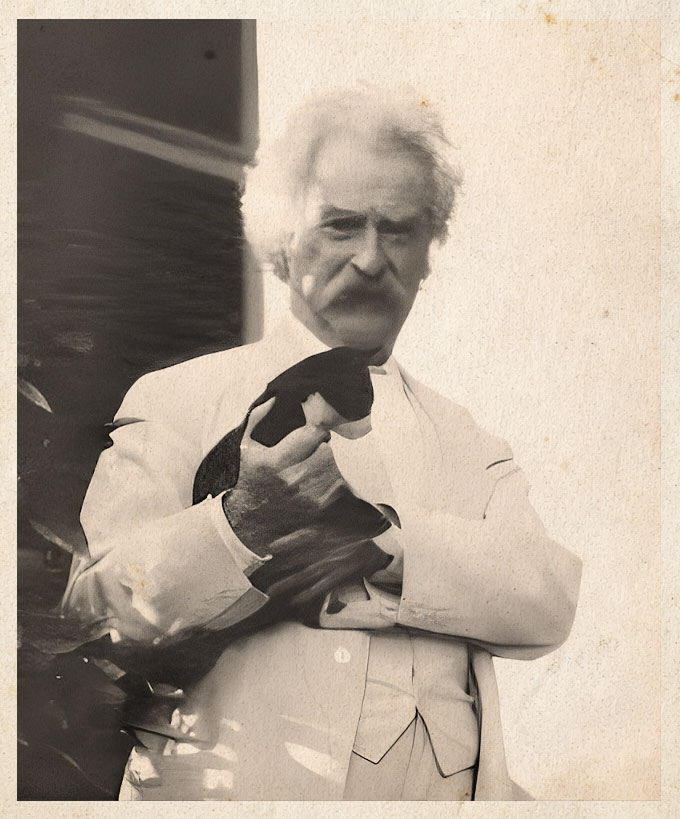
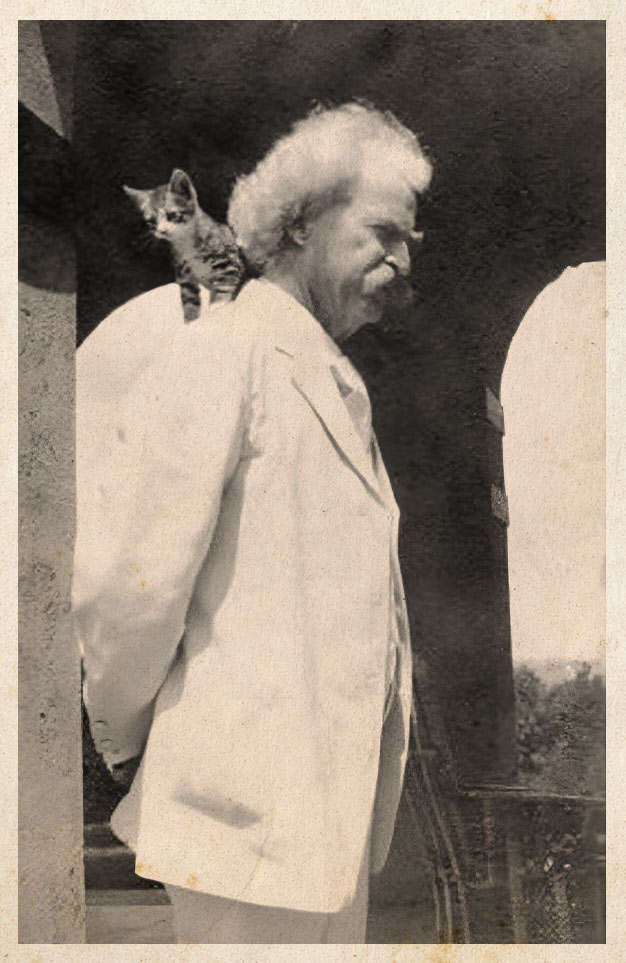
Twain featured several cat characters in his fiction, and they often stalked through his books, making cameos to add humor or highlight the personality of his human characters.
Twain’s most famous fictional cat, Peter, appeared in The Adventures of Tom Sawyer. In a famous scene, Tom gives Peter a dose of “Pain-Killer” (or, “hellfire”) medicine, causing the cat to go into a frantic, furniture-smashing frenzy before jumping out the window.
Later In the book, Tom Sawyer tells his brother, Sid, to give his “cat with one eye” to a new girl in town as his dying request while faking an illness.
Twain also featured the large grey cat, Tom Quartz, in his short story Dick Baker’s Cat, and portrayed as having “more hard, natchral sense than any man in the camp,” and a specialized knowledge of gold mining.
Mark Twain Rented Cats
Because Twain’s work required him to travel frequently for speaking engagements, he found it impossible to bring his own pets along on the road or across the ocean. To solve this, he became a prolific cat-renter, securing local kittens to keep him company during his travels. His most famous cat-renting spree took place in Dublin, New Hampshire, in 1906, where his biographer, Albert Bigelow Paine, witnessed him renting three kittens for the summer. (source)
Twain gave these temporary companions witty names that often reflected his feelings. For instance, after the death of his wife, he rented cats that he named, Sackcloth and Ashes as a Biblical reference to his deep sorrow at the time.
In the Bible, sackcloth and ashes symbolize deep mourning, humility, and sincere repentance before God. Sackcloth, a coarse, uncomfortable fabric, was worn to show grief, while ashes represented desolation and human frailty.
“He didn’t wish to own them, for then he would have to leave them behind uncared for, so he preferred to rent them and pay sufficiently to ensure their subsequent care.” – Twain biographer Albert B. Paine
He wasn’t just using them for entertainment, however; he was a great steward of these rented felines. When his summer stays ended, he would leave behind money to ensure the kittens were well-fed and cared for throughout all nine of their lives.
Twain’s Beloved Cat, Bambino
Perhaps the most significant feline in Twain’s life was Bambino, a “large and intensely black cat with thick, velvety fur”. Bambino was originally owned by Twain’s daughter, Clara, but when she was sent to a sanatorium after the death of Twain’s wife, Livy, the facility prohibited her from keeping the pet. Twain took Bambino in, and the cat became a vital companion that helped him through a deep depression.
The bond was so strong that when Bambino went missing from their home on 5th Avenue in New York City in 1906, a frantic Twain took out an advertisement in the New York American newspaper. He offered a $5 reward (about $200 now) for the “distinguished-looking” cat, describing him as having a “faint fringe of white hair across his chest” and being “not easy to find in ordinary light”.
While many people showed up at his door with cats they hoped would match the description, Bambino eventually found his own way home.
Mark Twain, Cat Lover
In the end, Mark Twain’s love of cats wasn’t just a quirky footnote. It was a window into who he really was. Beneath the sharp wit and satire was someone who deeply appreciated independence, personality, and quiet companionship; all qualities he found in cats.
Whether he was naming them with playful irreverence, surrounding himself with them at home, or even going out of his way to rent one while traveling, Twain treated cats as equals in a world he often viewed with skepticism. It’s no surprise that, more than a century later, his words about cats still resonate, because they reveal a timeless truth: cats don’t just live alongside us, they remind us how to live a little better.
Believe Chairman Meow!